
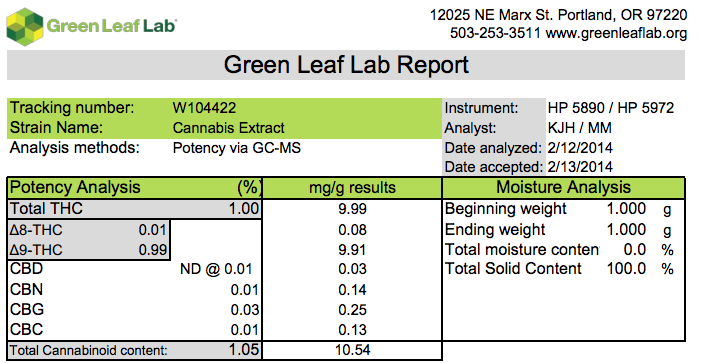
 The results are in for testing on the latest batch of ApothecArt Pure Cannabis Extract! These numbers may look low to those of you who are used to dealing only with flowers, but in the world of tinctures, we’re stoked!
Not pictured in the chart here but also present in ApothecArt results: .02 percent of CBG (Cannabigerol). As for our breakdown of THC (Delta-9 and Delta-8), we came in at .99 percent and .01 percent, respectively, with Total THC of 1% and 9.99 mg per gram of THC.
Here’s a brief refresher on the properties of THC, CBD, CBG and CBN (based on information provided by Green Leaf Labs):
- Delta-9 Tetrahydrocannabinol (Δ9-THC): This is the most common form of THC found in cannabis and the most commonly researched. Delta-9 cannabinoid is known for is euphoric affect, as well as a pain inhibitor.
- Delta-8 Tetrahydrocannabinol (Δ8-THC): Similar to Delta 9-THC and also known for its euphoric affect and analgesic properties. Some think it has a lessor affect since it is found in smaller quantities than Delta 9 THC.
- CBG (or Cannabigerol) is a non-psychoactive cannabinoid that’s thought to be the “stem cell” of the plant. Special enzymes in cannabis convert CBG into other cannabinoids. As a medicine, CBG is is known for it’s antibiotic, analgesic, antifungal and anti-inflammatory affects.
- CBD (or Cannabidiol) is primarily a non-psychoactive compound, known for it’s antioxidant, antispasmomdic, analgesic, antipsychotic and anti-inflammitory properties. Research has also shown that it may inhibit the expansion of some cancer cells.
- CBN (or Cannabinol) is the product of THC oxidation and occurs when the cannabis flower is exposed to oxygen. It can interact synergistically with THC and sometimes can accentuate the “couch lock” feeling some people experience. CBN is known for its sedative, antibiotic, anti-inflammatory and anticonvulsant properties.
 Remedies for Modern Life